
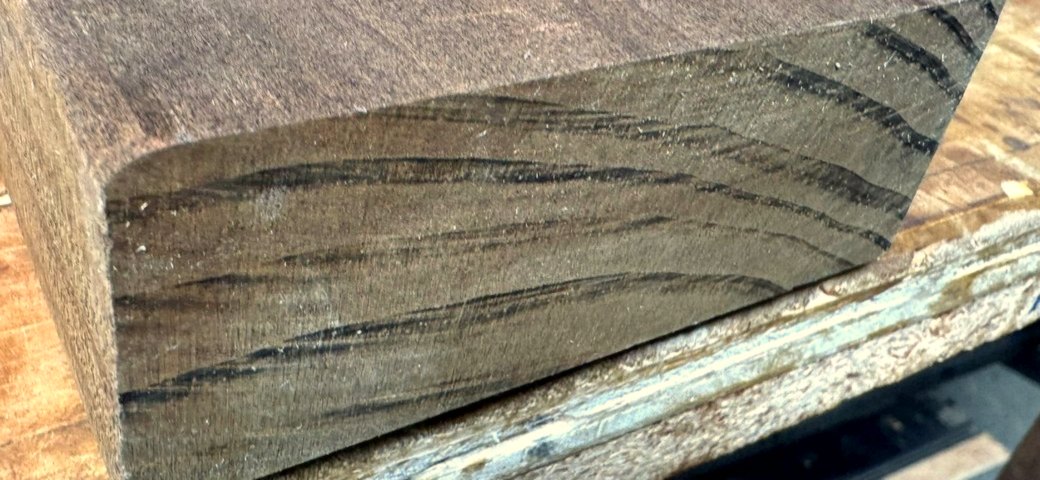
If you cut the end off a Kebony board, you’d probably expect to find lighter wood under the dark surface. It’s actually brown all the way through to the core.
At a glance, most people would take it for a tropical hardwood, but it starts out as pine. That’s not a species we’d normally spec for site furniture, and for good reason. Radiata pine is soft, it absorbs water, it moves with every change in the weather, and if it’s left outside long enough it will eventually rot.
Kebony changes that with a process that begins with agricultural waste. Leftovers such as corn cobs and sugarcane fiber can be turned into a plant-based liquid called furfuryl alcohol. That liquid is forced deep into the radiata pine under pressure and then heat-cured, which polymerizes it within the wood’s cell walls, where it stays. The process is called furfurylation. Because it happens inside the wood rather than on it, the color goes all the way through.
What comes out is a denser, harder board that takes on far less water, so it swells and shrinks much less. On a bench, that means a seat that holds up to heavy use, board spacing that stays more consistent from winter to summer, and edges that keep their line. It also earns the top durability class for rot resistance, without any biocides.
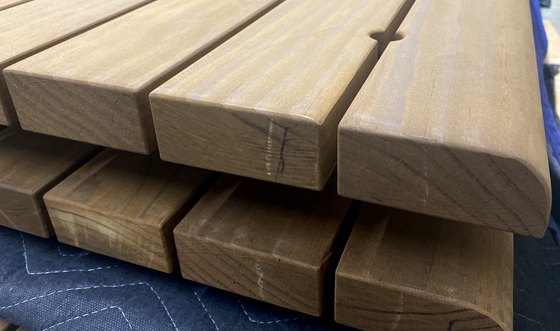
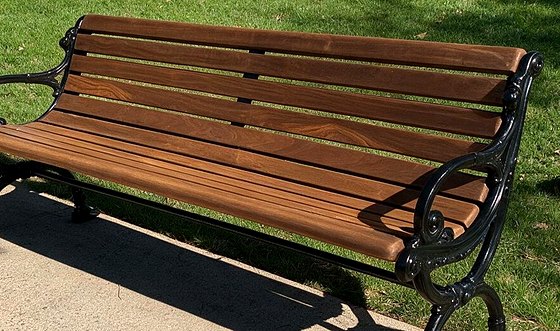
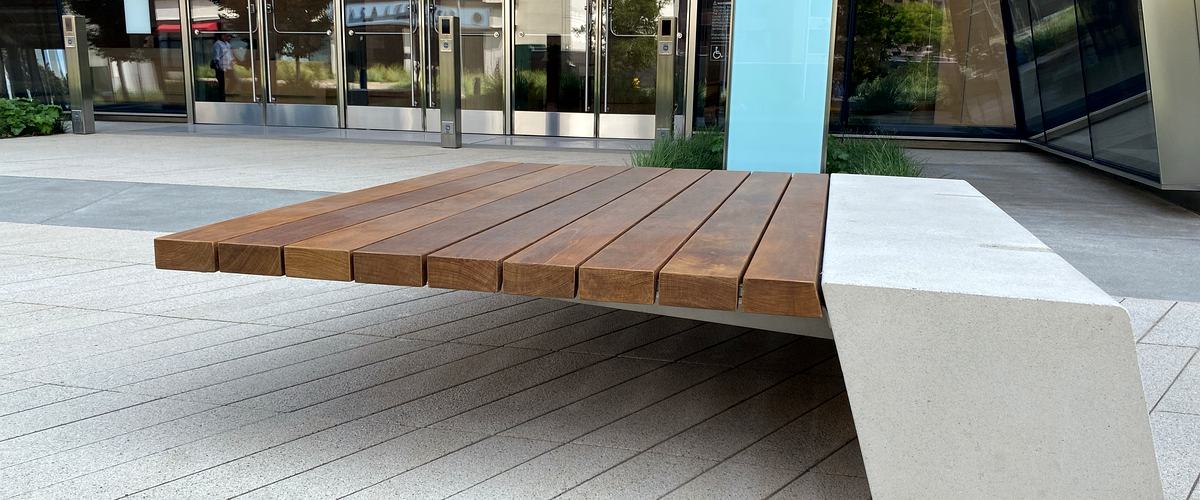
Left: Kebony milled and sanded. Right: Kebony on our Victoria Square Bench.
That doesn’t mean it stays brown on the surface forever. Outdoors, unmaintained Kebony slowly turns silver gray. Cut into it, though, and the wood underneath is still brown.
For projects with sustainability goals, it’s worth knowing the radiata pine comes from FSC-certified forests, and the finished boards carry the Nordic Swan Ecolabel.
Furfurylation itself isn’t new. Researchers have worked on it since the 1950s, but it only went into full-scale commercial production in Norway in the late 2000s.
Kebony earned its place as one of the three woods in the BraunMark system because it gives you the look and staying power of a hardwood, from a board that started as pine.
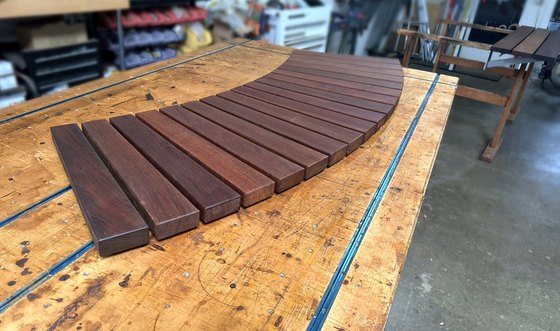
Straight benches follow a steady routine in the shop: cut, fit, fasten, and move on to the next board. Curves take more time. Each board has to follow the radius, so there’s more layout, more fitting, and more checking along the way.
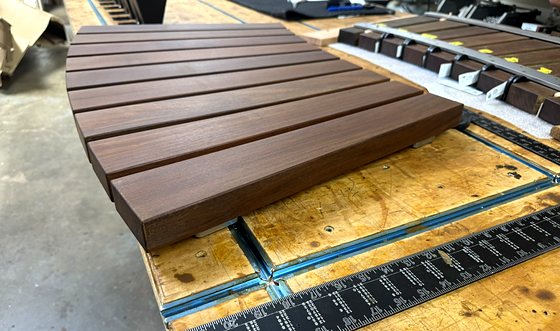
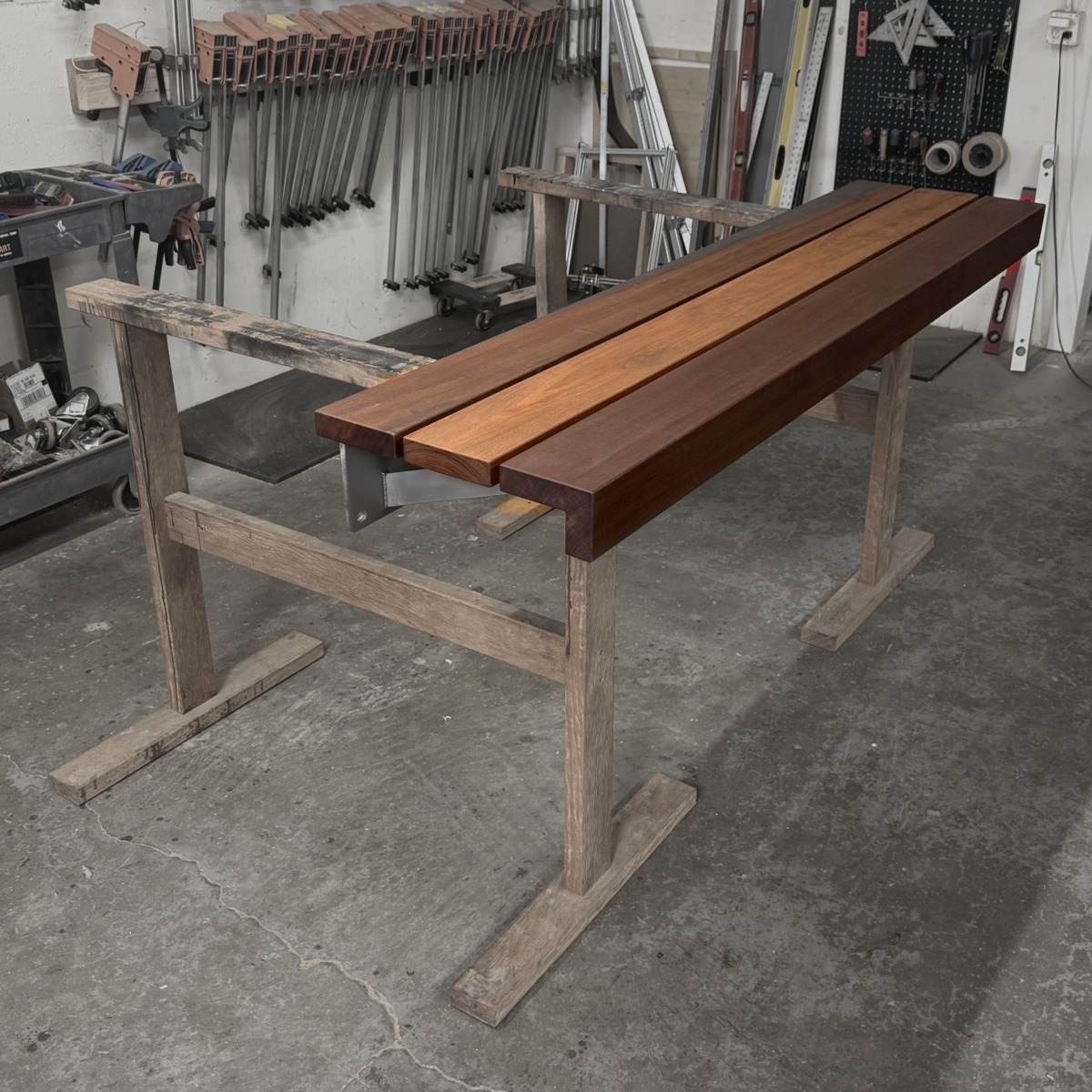
Left: on the bench, mid-build. Right: the curved Seatwall seat, its straight partner just behind.
The curved Seatwall seat for our second BraunMark project was built on the assembly table from short Ipe boards, set one at a time with the precision and care a curve needs. Its straight partner, a Cantilever Wall bench in the same Ipe, was built alongside it. Both pieces went to a commercial project in Sunnyvale, California.
With two projects now out the door, the BraunMark system is starting to find its stride.
Some of our favorite design conversations at DM Braun start with “I like it, but…”
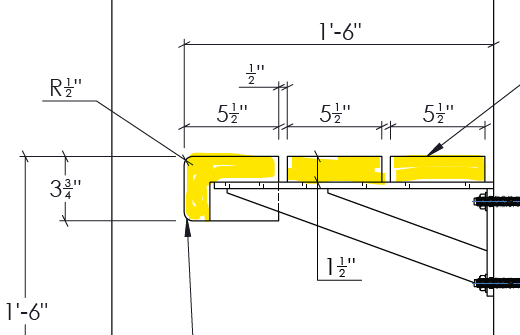
The second BraunMark project was a good example. The landscape architect envisioned a straight Cantilever Wall bench that felt heavier, with more presence at the front edge and less of a row-of-slats look. That look isn’t in the Spec Guide.
The standard design mills every seat board the same, like the two at the rear. This time we milled the front board to wrap down over the edge, with a ½” radius to soften it.
What changed: one board.
What stayed the same: the frame, the mounting and the spacing.
The result: a bench with a noticeably different look.
That’s how BraunMark works. It’s a pre-engineered, semi-custom bench system: a few design decisions get you to a finished bench, and behind them sit hundreds of configurations. Wood, board pattern, orientation, edge profile, layout, form, armrests, skirting.
With that many options, the Spec Guide could easily have run hundreds of pages. To keep specifying simple, we limited it to the most common elements. Once you’ve picked a bench type, though, the details are still open to you. The guide is meant to be a starting point for the conversation, not the final word.
If you’re looking at BraunMark for your next project and thinking “I like it, but…”, give us a call at (714) 674-0855 and let’s talk about the rest of that sentence.
Bench Notes comes out on the second Tuesday of every month, straight from the shop.